Dawnbreak AI
Dawnbreak AI – Smarter Healthcare Conversations

The Challenge
Doctors often spend valuable consultation time taking notes instead of fully engaging with their patients. Manual documentation leads to errors, inefficiency, and burnout, while patients may feel less heard during appointments. Traditional transcription tools are either inaccurate, lack medical context, or fail to integrate seamlessly into healthcare workflows.
Project Process & Timeline
Audited clinical consultation workflows and designed secure encryption data-consent consent flows.
Sketched record triggers, notes tagging, and structured transcript layouts for doctor reviews.
Tested app layouts with healthcare professionals, refined readability, and delivered handoff specs.
Understanding Clinical Insights & Information Architecture
I conducted qualitative interviews with attending physicians, medical scribes, and outpatient care teams to map clinical documentation bottlenecks. This led to an encrypted, multi-tier Information Architecture (IA) schema connecting ambient voice capture directly to automated SOAP notes, SNOMED-CT/ICD-10 terminology tagging, and EHR integration.
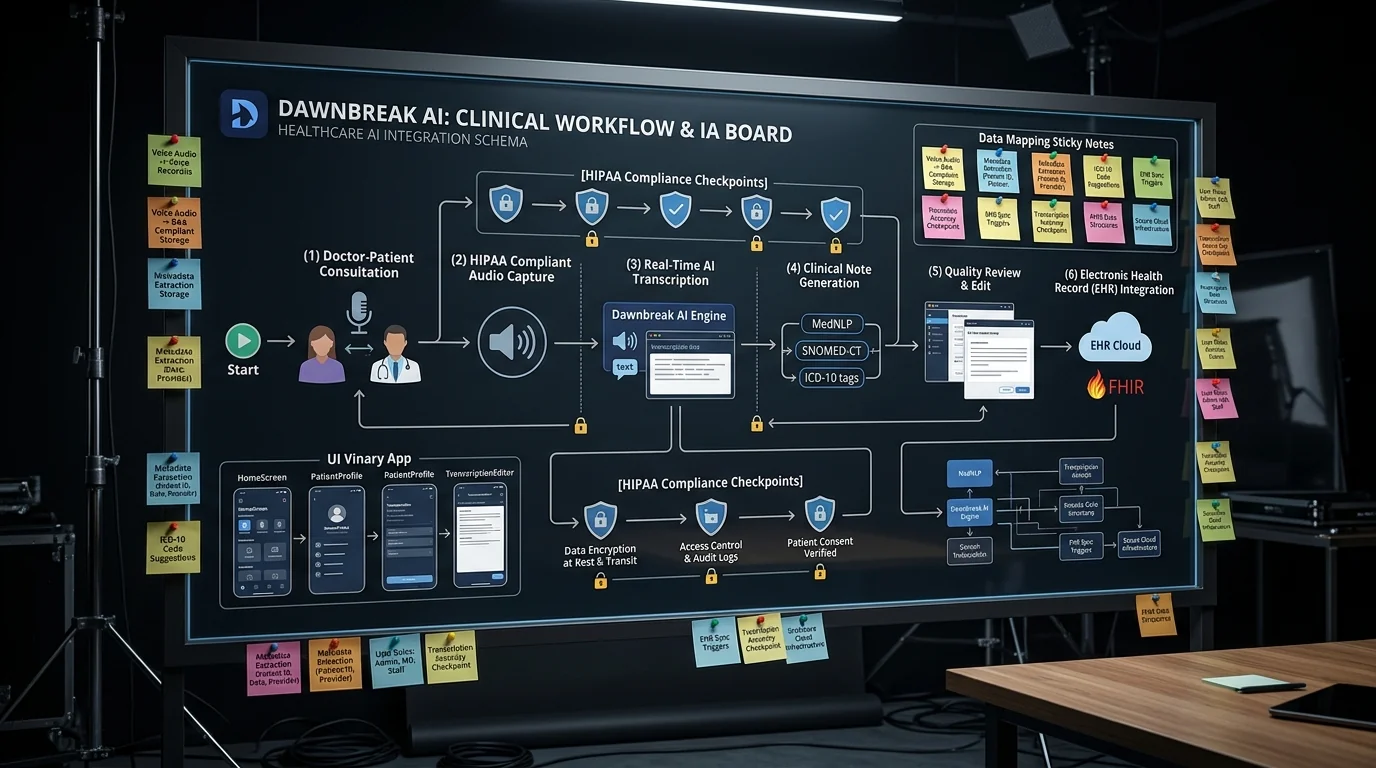
Dawnbreak AI Information Architecture & HIPAA-compliant clinical voice transcription workflow board.
Designing the System
Dawnbreak AI was designed as an intelligent healthcare communication platform that allows doctors to focus on patients — not paperwork. The app records doctor–patient conversations securely and automatically generates accurate, structured transcripts using AI. These transcripts are organized into medical summaries, helping doctors review cases faster and make more informed clinical decisions. The system also enables smooth communication between patients and healthcare professionals, promoting transparency and trust.
Note: Displaying selected core user flows and key screens only.
Overcoming Obstacles & Prototyping
One key challenge was ensuring transcription accuracy, especially for medical terminology and multi-speaker detection. Balancing a minimal, user-friendly interface with advanced features like real-time recording, playback, and note tagging required thoughtful design iterations. Privacy and data security were also top priorities; we implemented encrypted storage and clear consent flows to meet healthcare compliance standards. Through continuous testing with healthcare professionals, the design evolved into a tool that felt intuitive, reliable, and clinically relevant.
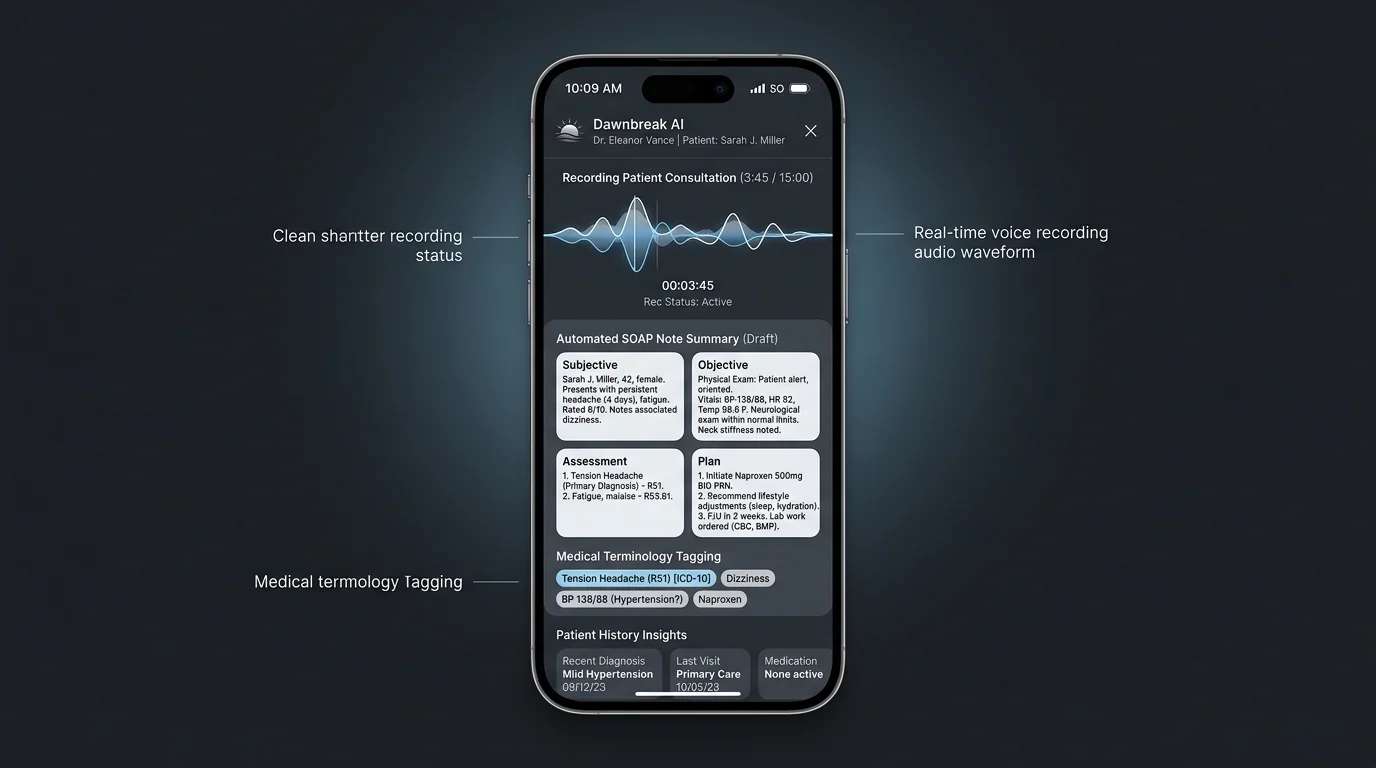
Dawnbreak AI mobile interface — real-time audio waveform recording & automated SOAP clinical note summary generator.
Medical Design System & UI Specs
A specialized healthcare design system was constructed to combine high clinical legibility with accessible interface states. Headings leverage Instrument Serif typography while data tables and medical badges use crisp Inter sans-serif typography.
#00a3ff
#0ea5e9
#10b981
#0f172a
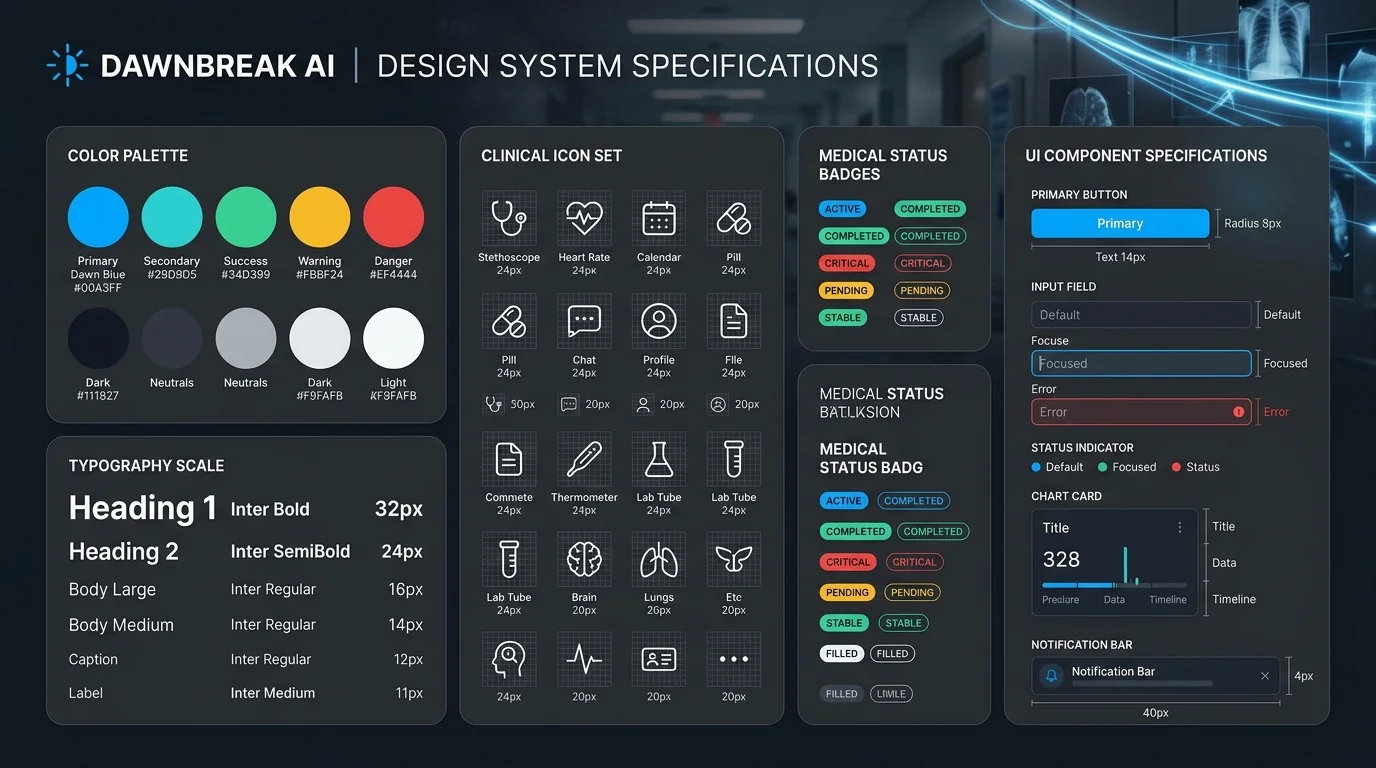
Dawnbreak AI medical design system — clinical icon set, status badges, typography scale, and component guidelines.
Doctor & Patient Validation Feedback
During clinical pilots across outpatient clinics, feedback was collected from both attending physicians and patients to evaluate time savings, accuracy, and emotional reassurance.
"Dawnbreak AI eliminated 2+ hours of evening charting every shift. Being able to speak naturally with patients while the system generates structured SOAP notes in real-time has completely restored my focus on patient care."
"The accuracy in capturing multi-speaker consultations and auto-tagging ICD-10 and SNOMED-CT codes is remarkable. It meets all HIPAA compliance requirements effortlessly."
"I used to forget half of what my doctor explained during consultations. Receiving a clear, jargon-free summary card directly on my app gave me total clarity on my treatment plan."
Key Results & Summary
Dawnbreak AI bridges the gap between medical expertise and intelligent automation. By reducing administrative workload and improving accuracy in documentation, it allows doctors to dedicate more attention to patient care. This project deepened my understanding of designing for healthcare technology — balancing usability, empathy, and compliance to create a seamless experience for both doctors and patients.
Key Takeaways & Reflections
Doctors require high visibility controls when recording patient interviews to maintain context.
Clear privacy indicators and encrypted summaries reassure patients during audio sessions.
Behance Presentation
View the complete layout, design system guidelines, and full mockup details.
Next Case Study
Career Connect — AI-Driven Job Placement & Skill Mapping